Rotterdam Storage Tank Farm: Bulk Liquid Storage Guide
September 29, 2026 · 15 min read
A storage tank farm search is a starting point, not proof that a facility can handle a particular cargo. Nominal capacity alone does not establish suitability. Product compatibility, segregation controls and transfer procedures determine whether cargo can be received, stored and moved in line with its requirements.
When assessing crude-oil or chemical-products storage, check how the proposed arrangement fits the product, volume, timing and transfer needs. Tank Holding B.V. provides storage, product segregation and quality assurance as an independent storage and terminal-logistics provider, not as a commodity counterparty.
This guide explains what to verify before entering a storage arrangement, from capacity and product suitability to receipt, transfer and quality-assurance procedures. It also shows how to prepare a focused enquiry with product specifications, required volume, timing and handling needs. Use these details to assess fit and cargo-integrity controls before committing.
Key Takeaways
- Assess a storage tank farm against cargo requirements and operating controls, not nominal capacity alone.
- Product compatibility, segregation and documented handling procedures support cargo integrity during storage and transfer.
- Confirm usable capacity and availability for the required product, volume and timing before proceeding.
- Prepare an enquiry with the product grade, volume, timing and handling requirements to support a focused assessment.
- Tank Holding B.V. provides crude-oil storage, chemical-products storage, product segregation and quality assurance as an independent storage and terminal-logistics provider.
What a storage tank farm does for bulk-liquid supply chains
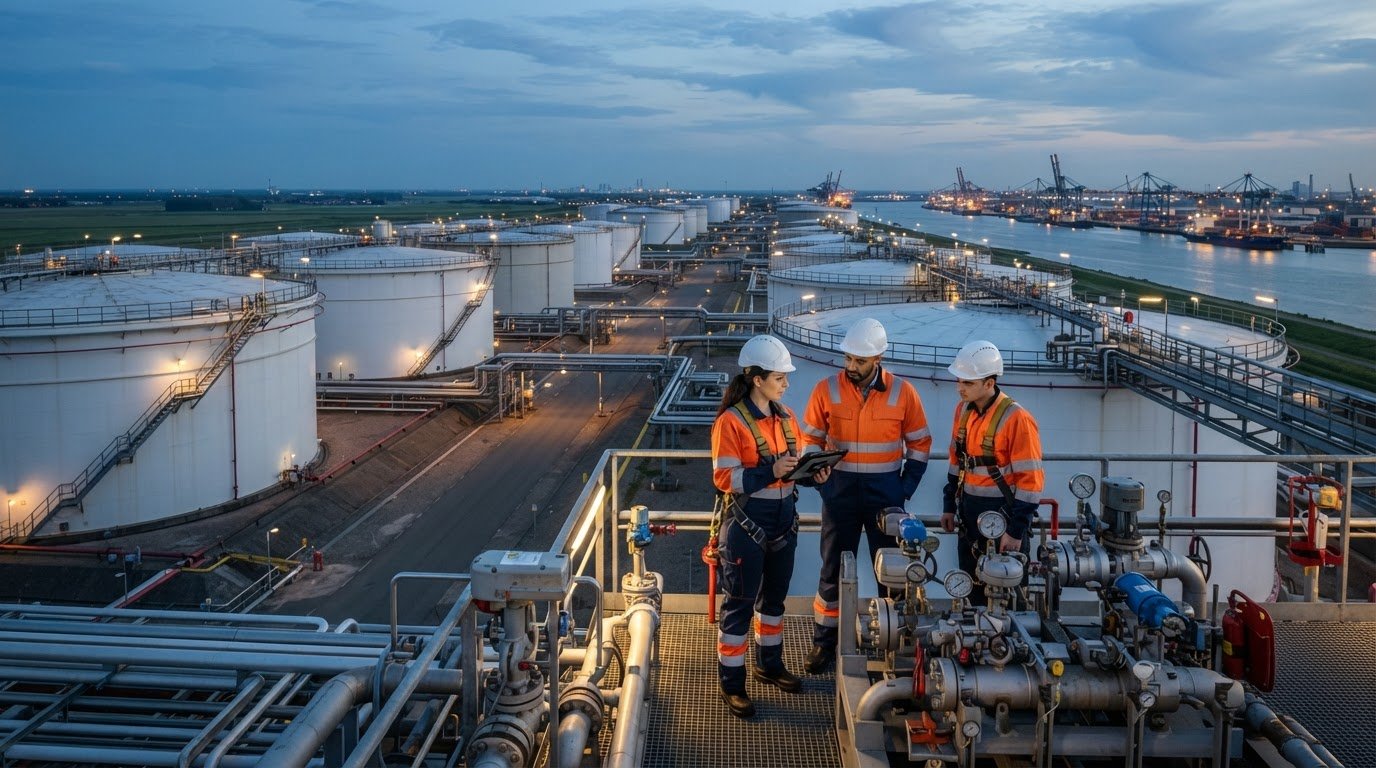
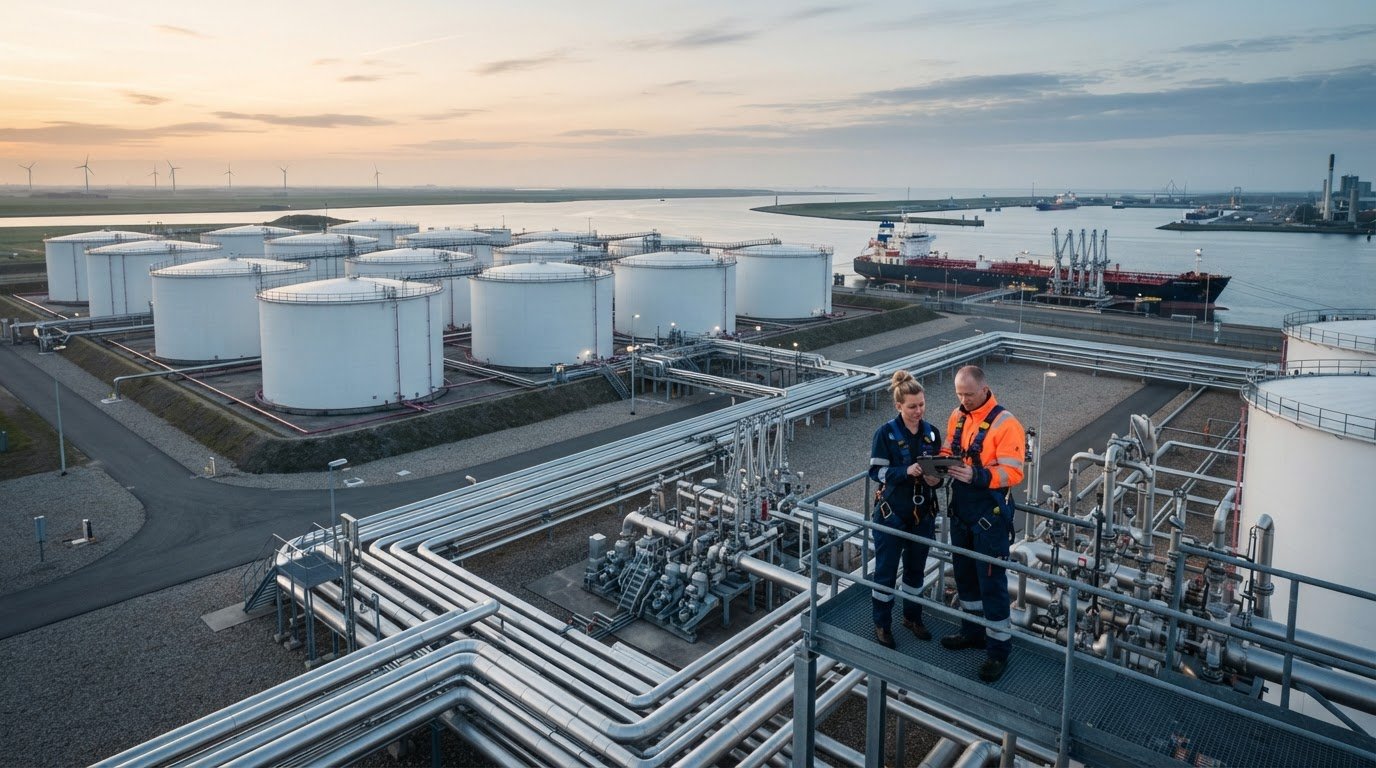
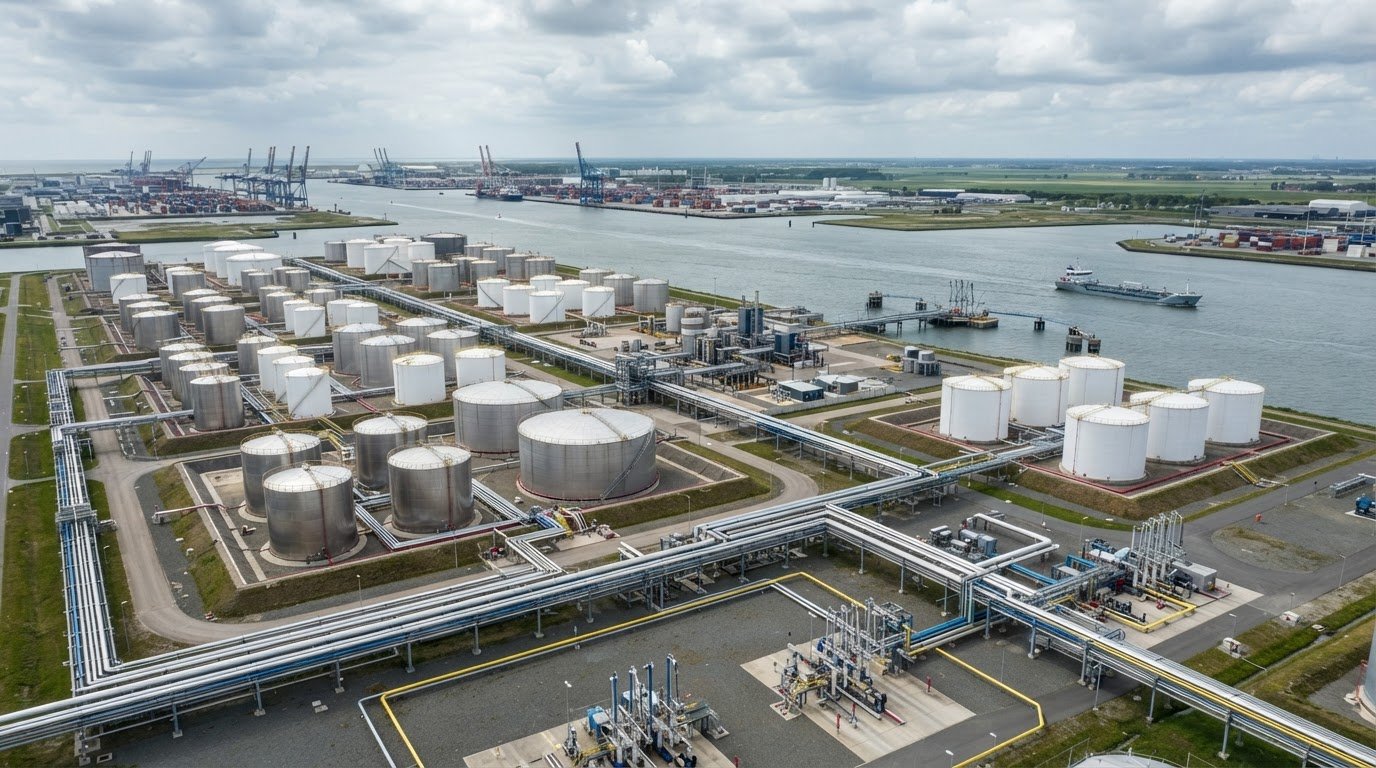
A storage tank farm is an organized facility for receiving, holding and transferring bulk liquids under defined operating controls. It provides an intermediate point in a supply chain, connecting producers and refiners with traders, suppliers and distributors. Its role is physical storage and terminal logistics, not ownership or sale of the commodity. When comparing providers, verify their confirmed capabilities against the cargo requirements instead of relying on a search phrase or general facility description.
For a foundational overview of terminal functions, see What is an oil terminal. The term “tank farm” can describe facilities with different products, equipment and operating scopes. A search for a particular tank farm does not confirm that a facility handles a given product or has suitable capacity available.
Which products and supply-chain requirements can storage support?
Crude oil, refined petroleum products and bulk-liquid chemicals are distinct cargo categories. Each has properties and handling requirements that must match confirmed facility capabilities. Compatibility may depend on the product specification, required segregation and available storage and transfer arrangements. A tank farm suitable for one liquid may not be suitable for another.
Before assessing a provider, define the cargo and operating profile: product and grade, expected volume, storage period, receipt and dispatch timing, and any handling or quality-assurance requirements. Ask which requirements the provider can support and request confirmation for the proposed cargo. Do not infer capability from a general facility description or total capacity figure.
What happens between receipt, storage and dispatch?
At a general level, the process covers receipt, controlled storage, inventory management and transfer for dispatch. The operating plan should explain how cargo is received, assigned to storage, kept separate where required and released for onward movement. Sampling, testing or blending should be treated as part of the arrangement only when the product and agreed service scope include those activities.
A tank farm connects supply-chain counterparties by receiving bulk liquid, holding it under agreed controls, tracking inventory and transferring it for dispatch. The specific handling and quality activities depend on the cargo and service scope.
These functions are separate from commodity trading and retail fuel dispensing. A storage provider supplies physical infrastructure and specified logistics functions; it does not necessarily buy or sell the stored product. Tank Holding B.V. describes itself as an independent storage infrastructure and terminal-logistics provider. Its stated services include crude-oil storage, chemical-products storage, product segregation and quality assurance. Confirm product suitability, capacity and service scope for the proposed arrangement.
How tank-farm controls protect product integrity during storage
Cargo integrity depends on more than the tank itself. Containment can limit the consequences of leaks, while product compatibility and controlled handling help preserve cargo condition. Procedures should explain how a product is received, stored, monitored and transferred. These controls reduce exposure to loss or contamination; they do not eliminate operational risk. Verify the proposed facility’s specific controls rather than making assumptions based on a location or facility description.
Containment arrangements and applicable requirements vary by facility and jurisdiction. The U.S. Environmental Protection Agency’s Spill Prevention, Control, and Countermeasure (SPCC) rule is a U.S. federal reference, not a statement of Dutch requirements. Confirm relevant local requirements and facility-specific controls rather than treating a foreign standard as proof of compliance.
How product segregation reduces cross-contamination exposure
Segregation keeps incompatible or distinct cargoes apart. Depending on the facility and agreed scope, this may involve dedicated tanks, isolated piping or separated manifolds. These arrangements can help preserve distinctions between product grades and batches and protect sensitive feedstocks from contact with other materials.
The required separation depends on the cargo and its specification. Confirm the proposed tank assignment, connected transfer route and procedures for shared equipment where relevant. A facility’s general segregation capability does not confirm that a particular arrangement is suitable for your product.
How quality assurance supports cargo integrity
Quality assurance may include checks at receipt, during storage and before transfer. Sampling or testing can help establish whether cargo aligns with an agreed specification, while monitoring and inventory records can support traceability. Define the checks, responsibilities and acceptance criteria in the storage agreement. Verify that the proposed activities are available for the product and facility.
Documented checks provide a traceable basis for comparing cargo condition with agreed specifications at defined handling stages. This is a control framework, not a guarantee that contamination or loss cannot occur.
Distinguish company-level service descriptions from the operating procedures for a specific arrangement. Tank Holding B.V. states that it provides product segregation and quality-assurance handling. Confirm the actual controls, records and procedures applicable to the proposed cargo. Review its stated storage and quality-assurance services as part of that assessment.
Why nominal capacity alone cannot establish tank-farm suitability
A published capacity figure does not show whether a tank can hold a specific product, whether capacity is available for the required period or whether the facility can support the planned transfer sequence. A sound assessment matches cargo properties and quality requirements with confirmed storage arrangements, segregation controls and the agreed service scope.
Assess each requirement as confirmed, conditional or unverified. Capacity, throughput and handling are separate considerations. Treat requested blending as a separate scope item. Do not assume it is available simply because a provider offers storage or transfer services.
Which technical and operational criteria should buyers compare?
Record the product type and grade, required quality parameters and any temperature conditions. Then document expected volume, receipt and dispatch timing, transfer sequence and inventory-management needs. Ask the provider what evidence supports each claimed capability, and whether it applies to the proposed cargo and period.
The OSHA standards for flammable liquids provide a U.S. reference, not Dutch regulatory guidance. Do not use them as evidence of compliance for a facility in the Netherlands. Confirm applicable requirements and facility-specific controls independently.
Requirement | Provider evidence | Unresolved question
- Product and grade: Written confirmation of suitability | Are the cargo properties and quality requirements accepted?
- Capacity and timing: Confirmation of usable capacity for the proposed period | Is that capacity available for the required dates?
- Segregation: Description of the proposed arrangement | Are the tank and transfer routes suitable for this cargo?
- Throughput and transfer: Defined receipt and dispatch process | Can the expected volumes and timing be accommodated?
- Additional services: Written scope for any requested activity | Is it included, conditional or outside the proposed arrangement?
How should buyers evaluate storage versus throughput needs?
Storage concerns how much cargo can be held and for how long. Throughput concerns the movement of cargo into and out of storage. A large nominal tank may not resolve a timing constraint if the proposed receipt or dispatch sequence is unsuitable. Compare expected volumes and transfer dates with the provider’s confirmed operating scope. For additional context, see reliable petroleum storage facility solutions.
Before treating a facility as a fit, obtain written confirmation of usable capacity, product suitability, availability, transfer requirements and any additional requested services.
How to conduct tank-farm due diligence before requesting capacity
A structured enquiry helps a provider assess cargo fit and identify unresolved requirements. Separate the information you supply from the evidence the provider returns. Treat general portfolio figures as background only: they do not confirm product suitability, available capacity or a specific allocation.
What information should a storage enquiry include?
Prepare a cargo specification and operating profile before requesting capacity. Include the product identity, grade, relevant quality parameters, anticipated volume and required storage period. State any temperature conditions or other handling constraints, along with expected receipt dates, transfer requirements and intended dispatch timing.
Identify requested segregation and any sampling, testing or blending requirements. Confirm these activities as part of the proposed service scope rather than assuming they are included in storage. A complete enquiry gives the provider a defined basis for assessing the request and identifying any conditions.
What should buyers confirm before committing cargo?
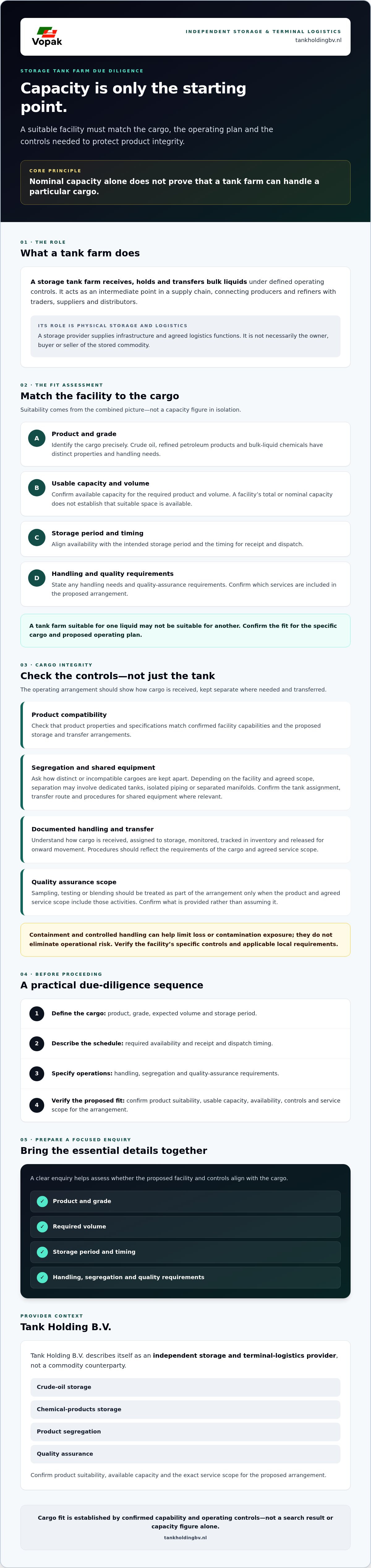
Use this sequence to structure due diligence:
- 1. Define the cargo. Document product, grade, quality parameters, volume, storage period and handling constraints.
- 2. Specify the operating profile. Set out the receipt schedule, transfer needs, dispatch timing and requested segregation or quality-related services.
- 3. Request provider evidence. Ask for the procedures, controls and service scope relevant to the proposed product and handling sequence. Distinguish documented practices from general capability statements.
- 4. Resolve technical and regulatory questions. Have qualified, current advisers verify applicable legal, regulatory and technical requirements for the cargo and proposed facility. Confirm that any cited standards or operating specifications apply.
- 5. Obtain written confirmation. Secure confirmation of product compatibility, capacity availability for the required dates, proposed procedures, responsibilities, documentation and agreed service boundaries before committing cargo.
Compare the written response with the original enquiry. Mark each item as confirmed, conditional or unresolved. Clarify responsibility for quality records, handling decisions and agreed checks. If availability or suitability depends on further review, keep that condition explicit. A broad capacity statement is not evidence of an allocation for a particular product, volume or period.
For an assessment of crude-oil storage, chemical-products storage, segregation or quality assurance, submit your product, volume, timing and handling requirements to Tank Holding.
How Tank Holding approaches crude-oil and bulk-liquid storage enquiries
Tank Holding B.V. operates as an independent storage infrastructure and terminal-logistics provider. Its stated services include crude-oil storage, chemical-products storage, product segregation and quality assurance. It is a storage provider, not a crude-oil or fuel commodity trader or retail fuel dispenser. Product suitability, capacity and availability must be assessed against each proposed cargo and operating profile.
Company materials state a portfolio of more than 12 million CBM across 45 storage tanks. This describes the stated global portfolio, not capacity at a single facility or in a particular market. It does not confirm an allocation or current availability for a specific enquiry.
Which storage requirements can Tank Holding B.V. assess?
Enquiries may specify crude oil, petroleum products or bulk-liquid chemicals, including the cargo grade, quality requirements, volume and proposed storage period. Product segregation and quality assurance are among Tank Holding B.V.’s stated services. The specific arrangement must still be confirmed for the product and requested capacity.
Define receipt and transfer needs clearly. If the requirement includes inventory management, throughput or blending, identify it separately and request written confirmation of whether it falls within the proposed service scope. Do not infer facility location, local capacity or availability from global portfolio information.
What information should be prepared for an initial discussion?
A complete enquiry should establish the cargo and operating conditions that affect its storage. Provide:
- Product identity, grade and available cargo specifications.
- Approximate volume, required storage period and target timing.
- Receipt schedule and transfer requirements.
- Segregation needs and quality-assurance expectations.
- Required documentation, sampling or testing expectations, if applicable.
These details give the provider a defined basis for assessment and help distinguish confirmed requirements from items needing further review. Capacity figures alone do not establish product compatibility or secure a specific allocation.
Submit the cargo specifications, approximate volume, timing, transfer requirements and requested controls through the storage enquiry. Tank Holding B.V. can assess the stated requirements against its crude-oil storage, chemical-products storage, product segregation and quality-assurance scope. Confirm any proposed capacity, procedures and service boundaries in writing before committing cargo.
Set the storage criteria before committing cargo
Assessing a storage tank farm requires more than comparing nominal capacity. Confirm product compatibility, segregation arrangements, quality-assurance controls and suitable capacity availability for the required period. Define receipt, storage and transfer needs in advance, then obtain written confirmation of the proposed service scope. These steps create a clearer basis for evaluating operational fit and protecting cargo integrity.
Tank Holding B.V. identifies crude-oil storage and chemical-products storage among its stated services, alongside product segregation and quality-assurance handling. Facility suitability, specific capacity and availability must be assessed for each enquiry. Tank Holding operates as a storage and terminal-logistics provider, not as a commodity counterparty.
Prepare the product specification, grade, approximate volume, timing, transfer requirements and expected controls for review. Submit your product and storage requirements to Tank Holding for assessment. A precise enquiry is the first step toward an informed storage decision.
Frequently Asked Questions
What is a storage tank farm?
A storage tank farm is a facility that receives, stores and transfers bulk liquids through organized tank and terminal operations. It can serve as an intermediate point between producers, refiners, traders, suppliers and distributors. Products, storage arrangements and services vary by facility. Confirm that the specific provider can handle your product, grade, volume and transfer requirements instead of assuming all tank farms offer the same capabilities.
How do tank farms protect bulk liquids from cross-contamination?
Tank farms manage cross-contamination exposure through product compatibility assessment, segregation and controlled handling procedures. Depending on the facility, separation may involve dedicated tanks, isolated piping or distinct transfer routes. Confirm the actual arrangement for your cargo, including controls for shared equipment. Sampling, testing and documented checks may support specification control when included in the agreed service. These measures reduce exposure but cannot eliminate every operational risk.
Can one tank farm store crude oil and chemical products?
A provider may handle both categories, but suitability depends on confirmed facility capabilities and the proposed storage arrangement. Crude oil and chemical products have distinct properties and handling requirements. Confirm product compatibility, segregation, tank assignment and transfer procedures for the specific cargo. Tank Holding B.V. lists crude-oil storage and chemical-products storage among its services, but this does not establish that both are handled at the same facility or that capacity is available for a particular enquiry.
How is suitable tank-farm capacity determined for a cargo?
Suitable capacity is determined by matching the cargo’s product and grade, required volume and storage period with compatible, available capacity and the required service scope. Nominal capacity alone does not establish usable capacity or confirm an allocation. Check segregation needs, receipt and dispatch schedules, transfer requirements and agreed quality controls. Request written confirmation for the proposed product and timing before committing cargo.
What information should I provide when requesting tank storage?
Provide the product identity and grade, available quality specifications, approximate volume, required storage period and target timing. Include receipt schedules, transfer requirements and any temperature or handling constraints. State whether you require segregation, quality assurance, sampling, testing or blending, and identify documentation expectations. This information allows the provider to assess the request against its confirmed capabilities and clarify which requirements are supported, conditional or unresolved.
What happens if a stored product does not meet its agreed specification?
The response should follow the written storage agreement and applicable operating procedures. Before contracting, clarify how a discrepancy is identified, documented and communicated, who is responsible for sampling or testing, and who can authorize decisions about the cargo. Preserve relevant records and agree on the process for reviewing results and determining next steps. Do not assume a general quality-assurance offering defines the procedure for every product or arrangement.
Is tank-farm storage the same as commodity trading?
No. Tank-farm storage is a physical storage and terminal-logistics service. Commodity trading involves buying or selling the product, which is a separate commercial activity. A storage provider may serve traders, producers, refiners, suppliers and distributors without acting as a commodity counterparty. Tank Holding B.V. describes itself as an independent storage infrastructure and terminal-logistics provider; it does not offer crude-oil or fuel commodity trading or retail fuel dispensing.
Frequently Asked Questions
Crude oil, refined petroleum products and bulk-liquid chemicals are distinct cargo categories. Each has properties and handling requirements that must match confirmed facility capabilities. Compatibility may depend on the product specification, required segregation and available storage and transfer arrangements. A tank farm suitable for one liquid may not be suitable for another. Before assessing a provider, define the cargo and operating profile: product and grade, expected volume, storage period, receipt and dispatch timing, and any handling or quality-assurance requirements. Ask which requirements the provider can support and request confirmation for the proposed cargo. Do not infer capability from a general facility description or total capacity figure.
At a general level, the process covers receipt, controlled storage, inventory management and transfer for dispatch. The operating plan should explain how cargo is received, assigned to storage, kept separate where required and released for onward movement. Sampling, testing or blending should be treated as part of the arrangement only when the product and agreed service scope include those activities. A tank farm connects supply-chain counterparties by receiving bulk liquid, holding it under agreed controls, tracking inventory and transferring it for dispatch. The specific handling and quality activities depend on the cargo and service scope. These functions are separate from commodity trading and retail fuel dispensing. A storage provider supplies physical infrastructure and specified logistics functions; it does not necessarily buy or sell the stored product. Tank Holding B.V. describes itself as an independent storage infrastructure and terminal-logistics provider. Its stated services include crude-oil storage, chemical-products storage, product segregation and quality assurance. Confirm product suitability, capacity and service scope for the proposed arrangement. Cargo integrity depends on more than the tank itself. Containment can limit the consequences of leaks, while product compatibility and controlled handling help preserve cargo condition. Procedures should explain how a product is received, stored, monitored and transferred. These controls reduce exposure to loss or contamination; they do not eliminate operational risk. Verify the proposed facility’s specific controls rather than making assumptions based on a location or facility description. Containment arrangements and applicable requirements vary by facility and jurisdiction. The U.S. Environmental Protection Agency’s Spill Prevention, Control, and Countermeasure (SPCC) rule is a U.S. federal reference, not a statement of Dutch requirements. Confirm relevant local requirements and facility-specific controls rather than treating a foreign standard as proof of compliance.
Record the product type and grade, required quality parameters and any temperature conditions. Then document expected volume, receipt and dispatch timing, transfer sequence and inventory-management needs. Ask the provider what evidence supports each claimed capability, and whether it applies to the proposed cargo and period. The OSHA standards for flammable liquids provide a U.S. reference, not Dutch regulatory guidance. Do not use them as evidence of compliance for a facility in the Netherlands. Confirm applicable requirements and facility-specific controls independently. Requirement | Provider evidence | Unresolved question
Storage concerns how much cargo can be held and for how long. Throughput concerns the movement of cargo into and out of storage. A large nominal tank may not resolve a timing constraint if the proposed receipt or dispatch sequence is unsuitable. Compare expected volumes and transfer dates with the provider’s confirmed operating scope. For additional context, see reliable petroleum storage facility solutions. Before treating a facility as a fit, obtain written confirmation of usable capacity, product suitability, availability, transfer requirements and any additional requested services. A structured enquiry helps a provider assess cargo fit and identify unresolved requirements. Separate the information you supply from the evidence the provider returns. Treat general portfolio figures as background only: they do not confirm product suitability, available capacity or a specific allocation.
Prepare a cargo specification and operating profile before requesting capacity. Include the product identity, grade, relevant quality parameters, anticipated volume and required storage period. State any temperature conditions or other handling constraints, along with expected receipt dates, transfer requirements and intended dispatch timing. Identify requested segregation and any sampling, testing or blending requirements. Confirm these activities as part of the proposed service scope rather than assuming they are included in storage. A complete enquiry gives the provider a defined basis for assessing the request and identifying any conditions.
Use this sequence to structure due diligence: Compare the written response with the original enquiry. Mark each item as confirmed, conditional or unresolved. Clarify responsibility for quality records, handling decisions and agreed checks. If availability or suitability depends on further review, keep that condition explicit. A broad capacity statement is not evidence of an allocation for a particular product, volume or period. For an assessment of crude-oil storage, chemical-products storage, segregation or quality assurance, submit your product, volume, timing and handling requirements to Tank Holding. Tank Holding B.V. operates as an independent storage infrastructure and terminal-logistics provider. Its stated services include crude-oil storage, chemical-products storage, product segregation and quality assurance. It is a storage provider, not a crude-oil or fuel commodity trader or retail fuel dispenser. Product suitability, capacity and availability must be assessed against each proposed cargo and operating profile. Company materials state a portfolio of more than 12 million CBM across 45 storage tanks. This describes the stated global portfolio, not capacity at a single facility or in a particular market. It does not confirm an allocation or current availability for a specific enquiry.
Enquiries may specify crude oil, petroleum products or bulk-liquid chemicals, including the cargo grade, quality requirements, volume and proposed storage period. Product segregation and quality assurance are among Tank Holding’s stated services. The specific arrangement must still be confirmed for the product and requested capacity. Define receipt and transfer needs clearly. If the requirement includes inventory management, throughput or blending, identify it separately and request written confirmation of whether it falls within the proposed service scope. Do not infer facility location, local capacity or availability from global portfolio information.
A complete enquiry should establish the cargo and operating conditions that affect its storage. Provide: These details give the provider a defined basis for assessment and help distinguish confirmed requirements from items needing further review. Capacity figures alone do not establish product compatibility or secure a specific allocation. Submit the cargo specifications, approximate volume, timing, transfer requirements and requested controls through the storage enquiry. Tank Holding can assess the stated requirements against its crude-oil storage, chemical-products storage, product segregation and quality-assurance scope. Confirm any proposed capacity, procedures and service boundaries in writing before committing cargo. Assessing a storage tank farm requires more than comparing nominal capacity. Confirm product compatibility, segregation arrangements, quality-assurance controls and suitable capacity availability for the required period. Define receipt, storage and transfer needs in advance, then obtain written confirmation of the proposed service scope. These steps create a clearer basis for evaluating operational fit and protecting cargo integrity. Tank Holding B.V. identifies crude-oil storage and chemical-products storage among its stated services, alongside product segregation and quality-assurance handling. Facility suitability, specific capacity and availability must be assessed for each enquiry. Tank Holding operates as a storage and terminal-logistics provider, not as a commodity counterparty. Prepare the product specification, grade, approximate volume, timing, transfer requirements and expected controls for review. Submit your product and storage requirements to Tank Holding for assessment. A precise enquiry is the first step toward an informed storage decision.
A storage tank farm is a facility that receives, stores and transfers bulk liquids through organized tank and terminal operations. It can serve as an intermediate point between producers, refiners, traders, suppliers and distributors. Products, storage arrangements and services vary by facility. Confirm that the specific provider can handle your product, grade, volume and transfer requirements instead of assuming all tank farms offer the same capabilities.
Tank farms manage cross-contamination exposure through product compatibility assessment, segregation and controlled handling procedures. Depending on the facility, separation may involve dedicated tanks, isolated piping or distinct transfer routes. Confirm the actual arrangement for your cargo, including controls for shared equipment. Sampling, testing and documented checks may support specification control when included in the agreed service. These measures reduce exposure but cannot eliminate every operational risk.
A provider may handle both categories, but suitability depends on confirmed facility capabilities and the proposed storage arrangement. Crude oil and chemical products have distinct properties and handling requirements. Confirm product compatibility, segregation, tank assignment and transfer procedures for the specific cargo. Tank Holding B.V. lists crude-oil storage and chemical-products storage among its services, but this does not establish that both are handled at the same facility or that capacity is available for a particular enquiry.
Suitable capacity is determined by matching the cargo’s product and grade, required volume and storage period with compatible, available capacity and the required service scope. Nominal capacity alone does not establish usable capacity or confirm an allocation. Check segregation needs, receipt and dispatch schedules, transfer requirements and agreed quality controls. Request written confirmation for the proposed product and timing before committing cargo.
Provide the product identity and grade, available quality specifications, approximate volume, required storage period and target timing. Include receipt schedules, transfer requirements and any temperature or handling constraints. State whether you require segregation, quality assurance, sampling, testing or blending, and identify documentation expectations. This information allows the provider to assess the request against its confirmed capabilities and clarify which requirements are supported, conditional or unresolved.
The response should follow the written storage agreement and applicable operating procedures. Before contracting, clarify how a discrepancy is identified, documented and communicated, who is responsible for sampling or testing, and who can authorize decisions about the cargo. Preserve relevant records and agree on the process for reviewing results and determining next steps. Do not assume a general quality-assurance offering defines the procedure for every product or arrangement.
No. Tank-farm storage is a physical storage and terminal-logistics service. Commodity trading involves buying or selling the product, which is a separate commercial activity. A storage provider may serve traders, producers, refiners, suppliers and distributors without acting as a commodity counterparty. Tank Holding B.V. describes itself as an independent storage infrastructure and terminal-logistics provider; it does not offer crude-oil or fuel commodity trading or retail fuel dispensing.