

Reliable Petroleum Storage Facility Solutions
September 28, 2026 · 15 min read
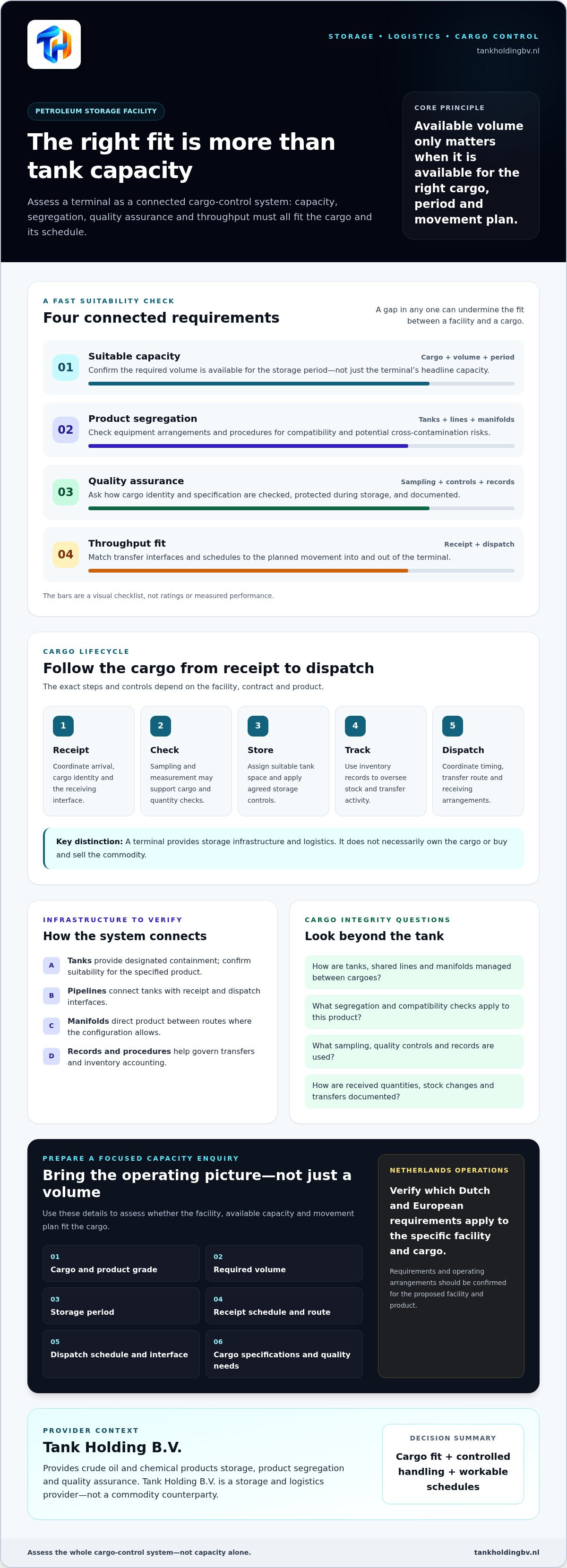
Tank capacity alone does not establish whether a terminal can protect cargo or meet a delivery schedule. A Petroleum Storage Facitlity must work as a controlled logistics system, with suitable capacity, product segregation, quality assurance and throughput matched to the cargo’s requirements.
Capacity is a useful starting point, but it does not confirm that the required volume is available for the right period, that products can be kept separate, or that handling procedures will maintain the cargo’s specification. For operations in the Netherlands, verify which Dutch and European requirements apply to the specific facility and cargo.
This article explains the core functions and infrastructure of a petroleum storage facility, then outlines practical criteria for assessing a provider beyond headline capacity. It covers containment, segregation, quality controls and cargo movement, along with the information to prepare for a capacity enquiry. Tank Holding B.V. provides crude oil and chemical products storage, product segregation and quality assurance. It is a storage and logistics provider, not a commodity counterparty.
Key Takeaways
- Assess a Petroleum Storage Facitlity as a connected cargo-control system, not by nominal tank capacity alone.
- Define the cargo, grade, volume and storage period before comparing facility suitability and available capacity.
- Check how tanks, shared lines and manifolds are managed to identify potential cross-contamination risks.
- Ask about segregation, sampling, quality assurance and records to evaluate product-integrity controls.
- Prepare receipt and dispatch schedules alongside cargo specifications for a focused storage-capacity enquiry.
What a Petroleum Storage Facility Does Across the Cargo Lifecycle
A Petroleum Storage Facitlity receives, holds, controls and transfers bulk liquid cargo as part of a supply chain. Its role extends beyond providing tank space. Tanks, pipelines, manifolds and transfer interfaces support the movement of cargo from receipt to dispatch. Equipment and procedures vary by facility and cargo. The Oil terminal overview provides background on common terminal infrastructure.
How a storage terminal fits into the petroleum supply chain
Storage connects producers, refiners, suppliers, distributors and traders by holding inventory between supply and onward movement. The terminal provides infrastructure and logistics. It does not necessarily own the cargo or buy and sell the commodity. Inventory positioning concerns where cargo is held and when it can move; trading concerns commercial ownership and transactions.
Capacity has operational value only when it fits the receipt and dispatch arrangements. Cargo may arrive through one transfer route and leave through another, depending on the facility’s interfaces and the parties’ schedules. Assess both the storage period and the planned movement into and out of the terminal.
From receipt to dispatch
The cargo lifecycle can include receipt, sampling, measurement, storage, transfer and dispatch. The exact steps and controls depend on the facility, contract and product. Before storage, parties may need to establish cargo identity and relevant quality information. During storage, inventory records and agreed controls support oversight. For transfer or dispatch, the parties coordinate the cargo, timing and receiving arrangements. Confirm the applicable process with the provider instead of assuming all terminals work the same way.
Which bulk liquids may require dedicated storage
Facilities may handle crude oil, refined petroleum products or chemical products, but capability with one category does not establish suitability for every product or grade. Cargo properties affect compatibility and handling requirements, including tank selection, segregation, transfer arrangements and the controls needed to maintain specification.
Shared equipment also warrants scrutiny. Tanks, lines and manifolds may serve more than one cargo route, so ask how the facility assesses compatibility and manages transfer sequences. The question is not only whether a tank has enough volume. Confirm that the proposed tank and connected equipment suit the specified cargo, and that the facility’s capabilities match the planned storage and movement. Tank Holding B.V. provides crude oil and chemical products storage, product segregation and quality assurance. Confirm the proposed arrangement for your cargo.
How Petroleum Storage Facilities Control Tanks, Transfers and Inventory
Tank capacity is only one part of facility control. A Petroleum Storage Facitlity uses connected equipment and procedures to govern where cargo enters, how it moves, where it is held and how inventory is accounted for. Confirm equipment configuration and operating arrangements for the specific facility and product.
Tank and transfer infrastructure
Tanks provide designated containment. Pipelines connect tanks to receipt and dispatch interfaces, while manifolds direct product between routes where the facility’s configuration allows. Together, these systems determine how cargo can move through the terminal. Dedicated or isolated equipment can support product separation, but verify the arrangement rather than assuming it is available.
Tank design is one part of the assessment. The American Petroleum Institute’s API Standard 650 addresses welded storage tank design and construction. A reference to a standard does not prove that a particular tank complies with it or suits a particular cargo. Confirm the tank’s design basis, condition, connections and compatibility with the product and transfer route.
At receipt, procedures may include cargo identification, sampling and measurement. During storage, the facility assigns the cargo to a tank and monitors stock through its applicable controls. At dispatch, the operator coordinates the required transfer to the designated interface. Steps, methods and records vary, so request a facility-specific explanation.
Inventory visibility and throughput coordination
Tank gauging and documented inventory records can help reconcile stock with receipt and dispatch activity. Ask how the provider records received quantities, tracks changes in stored inventory and documents transfers. Clarify which measurement methods and records apply to the proposed cargo. These details support operational visibility, but do not establish a universal procedure or service level.
Receipt windows, current stock, tank allocation and planned dispatch all affect whether capacity is usable for a particular schedule. A tank may have physical volume available but still be unsuitable because of its allocation, product compatibility or connected transfer route.
Physical storage capacity is the volume a facility can contain; operationally suitable capacity is the volume available for a specified cargo, tank configuration and receipt or dispatch schedule. This distinction is central to an accurate capacity assessment.
For a cargo-specific discussion, compare your requirements with the provider’s confirmed crude oil and chemical storage capabilities, including product segregation and quality assurance.
How to Assess Segregation, Quality Assurance and Cargo Integrity
Capacity and transfer arrangements establish whether cargo can be stored and moved. Product integrity also depends on tank allocation, equipment configuration, operating procedures and quality records. Assess these controls against the product, grade and batch in scope. Evaluate a Petroleum Storage Facitlity on the controls it can confirm for your operation, not on general quality claims.
Product segregation and contamination controls
Dedicated tanks or isolated piping can help keep distinct products, grades or batches separate when the facility’s configuration supports that arrangement. Shared tanks, lines and manifolds may introduce cross-contamination risks, particularly when equipment serves successive cargoes. The risk depends on product compatibility, prior service, line configuration and transfer sequence. Ask the provider to explain the controls relevant to your cargo. A separate tank assignment alone does not establish separation throughout the transfer route.
| Cargo requirement | Provider questions |
|---|---|
| Distinct product, grade or batch | Can the cargo be assigned dedicated or isolated tanks and transfer equipment? Which parts of the route are shared? |
| Defined quality parameters | What sampling or testing is available, at which operational stages, and against which agreed requirements? |
| Ongoing stock oversight | What monitoring or inventory records are maintained during storage, and how are changes recorded? |
| Documented receipt and dispatch | Which quality and transfer records connect the incoming cargo to the outgoing movement? |
Sampling, testing and quality records
Sampling and testing are verification steps, not universal procedures. Their scope should reflect the cargo requirements and the parties’ agreed specifications. Clarify who performs or arranges each step, what the result verifies, and how discrepancies are recorded and escalated. Establish whether samples or test records relate to receipt, stored inventory, dispatch, or a defined combination of stages.
Documentation should make cargo status clear across handovers. Ask how records identify the product and batch, link results to the relevant receipt or transfer, and show changes to the inventory record. Confirm which records are available. Do not assume a particular testing method or monitoring frequency without facility-specific confirmation.
Cargo integrity depends on linked controls across receipt, storage and transfer, because a gap at any stage can weaken confidence in the cargo’s identity or specification at dispatch. To compare providers, match each cargo requirement to a defined control and supporting record, then verify that the proposed arrangement covers the full route.
Matching Petroleum Storage to Operating Requirements
A storage enquiry is useful only when it defines the cargo and operating window. A Petroleum Storage Facitlity may have available volume but still be unsuitable if the tank, segregation arrangement or transfer schedule does not match the requirement. Use a structured assessment before comparing providers.
Specify the cargo and service requirement
Prepare the essential information first. Separate fixed requirements from preferences so the provider can assess operational fit, not just headline capacity.
- Identify the product and grade. State the cargo clearly and provide the relevant specification or quality requirements.
- Define the volume. Give the expected quantity and note any expected changes during the storage period.
- Set the storage period. Provide the expected arrival window, storage duration and any known timing uncertainty.
- Describe handling needs. Identify required segregation, quality assurance and product-specific handling requirements for assessment.
- Map receipt and dispatch. State expected transfer frequency, schedule constraints, dispatch timing and any limits on movement.
This makes constraints visible early. For example, cargo requiring a distinct grade allocation and a narrow dispatch window needs both compatible tank capacity and a suitable schedule. Identify preferences, such as additional scheduling flexibility, separately from requirements that determine whether the facility is acceptable.
Review operational fit and provider controls
Compare your requirements with the provider’s facility-specific response. Ask how tank compatibility is assessed, what segregation arrangement is proposed and which parts of the transfer route may be shared. Request details on quality assurance, records for receipt and dispatch, inventory reporting and transfer coordination. Confirm who is responsible for each operational action and decision.
Assess capacity against tank suitability and the full schedule, not volume alone. Clarify contractual scope, documentation, communication channels and responsibility boundaries before committing. Verify which Dutch and European requirements apply to the specific product and facility. A general statement of compliance does not resolve cargo-specific obligations, so obtain appropriate confirmation for the proposed operation.
A complete enquiry lets the provider assess crude oil or chemical products storage, segregation and quality assurance against defined requirements. Submit your storage-capacity enquiry with the cargo, volume, storage period and anticipated receipt and dispatch schedule.
Tank Holding B.V. and the Next Steps in a Storage-Capacity Enquiry
Tank Holding B.V. is an independent storage infrastructure and terminal logistics provider. Its offerings include crude oil storage, chemical products storage, product segregation and quality assurance. Suitability depends on the product, grade, volume, schedule and facility-specific requirements. Confirm the proposed arrangement directly before proceeding.
Where Tank Holding B.V. fits in the storage market
The company provides storage and terminal logistics, not commodity trading or retail fuel dispensing. This distinction helps clarify responsibilities: a storage provider supplies infrastructure and storage-related capabilities, while cargo ownership and commodity transactions remain separate matters.
Tank Holding B.V. oversees more than 12 million CBM of capacity across 45 storage tanks. Aggregate network capacity does not establish that a suitable tank, product segregation arrangement or operating window is available for a particular cargo. Request confirmation against your specific requirements.
Product segregation and quality assurance can be relevant to maintaining cargo identity and specification. Their application depends on the cargo and proposed operation. Confirm which controls and records apply to the receipt, storage and dispatch arrangement under consideration. A general capability statement does not confirm a specific tank allocation or its availability.
What to include in a storage-capacity enquiry
A complete enquiry gives the provider the information needed to assess operational fit. Include:
- Product and grade: Identify the cargo and provide the relevant specification or quality requirements.
- Volume and storage period: State the expected quantity, arrival window and required duration.
- Receipt and dispatch timing: Provide anticipated dates or scheduling windows, transfer frequency and known constraints.
- Segregation requirements: Specify whether the cargo must remain separate from other products, grades or batches.
- Quality assurance needs: Describe the checks, records or other cargo-specific expectations for assessment.
Separate mandatory conditions from preferences, and identify timing uncertainty or expected changes in volume. This helps the provider respond to your defined operating need rather than a general request for tank space.
For a cargo-specific capacity assessment, submit a storage-capacity enquiry with the product, grade, volume, expected storage period, receipt and dispatch timing, and applicable segregation or quality requirements.
Advance Your Storage Assessment with Defined Requirements
Selecting a reliable Petroleum Storage Facitlity requires more than comparing nominal tank volumes. Confirm that the cargo type, grade, tank suitability, segregation controls and receipt and dispatch schedules align. Review quality assurance processes and records across the cargo lifecycle, then establish responsibilities and applicable requirements before committing.
Tank Holding B.V. is an independent storage infrastructure and terminal logistics provider. Its offerings include crude oil storage, chemical products storage, product segregation and quality assurance. It does not trade commodities or dispense retail fuel. Its stated network capacity and tank count describe aggregate scale, not availability for a specific operation.
Prepare the product, grade, expected volume, storage period, transfer timing and cargo-specific quality or segregation requirements. Use these details to request a facility-specific assessment. Submit a storage-capacity enquiry to begin. Clear requirements provide a stronger basis for evaluating operational fit and progressing your storage planning.
Frequently Asked Questions
What is a petroleum storage facility?
A Petroleum Storage Facitlity is infrastructure for receiving, holding, controlling and transferring bulk liquid cargo. It can include storage tanks and connected equipment that move products between receipt and dispatch points. The facility supports supply-chain operations by positioning inventory; it does not necessarily own the stored cargo. Products and operating capabilities differ by facility, so confirm that the proposed facility can accommodate your cargo and schedule.
How does a petroleum storage facility work?
A petroleum storage facility coordinates cargo receipt, storage and dispatch through tanks, pipelines, manifolds and transfer interfaces. Depending on the cargo and agreed procedures, receipt may involve identification, sampling and measurement. The facility assigns inventory to storage and tracks it using applicable controls and records. For dispatch, the parties coordinate timing and transfer arrangements. Procedures and measurement methods vary, so confirm them directly with the provider.
What products can a petroleum storage facility store?
Facilities may be designed for crude oil, refined petroleum products or chemical products, but a site that stores one category may not suit every product or grade. Cargo properties influence tank compatibility, segregation and handling requirements. Tank Holding B.V.’s offerings include crude oil storage and chemical products storage. Ask the provider to assess your specific product, grade and requirements before treating capacity as suitable.
How do storage facilities prevent petroleum product contamination?
Facilities may use dedicated tanks, isolated piping or defined transfer procedures to maintain separation between products, grades or batches. Controls should account for shared tanks, lines, manifolds and transfer sequences where applicable. Ask how the proposed arrangement addresses your cargo’s compatibility and what sampling, testing or quality records are available. A general statement cannot guarantee contamination prevention; verify the controls and their scope for the specific operation.
How do I choose the right petroleum storage facility?
Compare operational suitability, not just nominal tank capacity. Define your product, grade, volume and storage period, then assess tank compatibility, segregation needs and receipt and dispatch schedules. Request details on quality assurance, inventory records, transfer coordination and responsibility boundaries. For a facility in the Netherlands, verify which Dutch and European requirements apply to the specific product and operation. Confirm availability and suitability directly with the provider.
Does a petroleum storage provider trade the products it stores?
Not necessarily. A storage provider may supply tank capacity and terminal logistics without owning or trading the stored commodity. These are separate commercial roles, and the provider’s scope should be confirmed in its contractual terms. Tank Holding B.V. operates as an independent storage infrastructure and terminal logistics provider. It does not participate in commodity trading or retail fuel dispensing. Clarify ownership, responsibilities and service scope before contracting.
What information should I include in a storage-capacity enquiry?
Include the product type and grade, expected volume and required storage period. Add anticipated receipt and dispatch timing, transfer frequency or schedule constraints, and any segregation or quality assurance requirements. Provide relevant product specifications if available, and distinguish mandatory conditions from preferences. This helps the provider assess whether suitable capacity and operating arrangements can be confirmed for your cargo. Verify availability and facility-specific procedures directly.
Frequently Asked Questions
A Petroleum Storage Facitlity is infrastructure for receiving, holding, controlling and transferring bulk liquid cargo. It can include storage tanks and connected equipment that move products between receipt and dispatch points. The facility supports supply-chain operations by positioning inventory; it does not necessarily own the stored cargo. Products and operating capabilities differ by facility, so confirm that the proposed facility can accommodate your cargo and schedule.
A petroleum storage facility coordinates cargo receipt, storage and dispatch through tanks, pipelines, manifolds and transfer interfaces. Depending on the cargo and agreed procedures, receipt may involve identification, sampling and measurement. The facility assigns inventory to storage and tracks it using applicable controls and records. For dispatch, the parties coordinate timing and transfer arrangements. Procedures and measurement methods vary, so confirm them directly with the provider.
Facilities may be designed for crude oil, refined petroleum products or chemical products, but a site that stores one category may not suit every product or grade. Cargo properties influence tank compatibility, segregation and handling requirements. Tank Holding B.V.’s offerings include crude oil storage and chemical products storage. Ask the provider to assess your specific product, grade and requirements before treating capacity as suitable.
Facilities may use dedicated tanks, isolated piping or defined transfer procedures to maintain separation between products, grades or batches. Controls should account for shared tanks, lines, manifolds and transfer sequences where applicable. Ask how the proposed arrangement addresses your cargo’s compatibility and what sampling, testing or quality records are available. A general statement cannot guarantee contamination prevention; verify the controls and their scope for the specific operation.
Compare operational suitability, not just nominal tank capacity. Define your product, grade, volume and storage period, then assess tank compatibility, segregation needs and receipt and dispatch schedules. Request details on quality assurance, inventory records, transfer coordination and responsibility boundaries. For a facility in the Netherlands, verify which Dutch and European requirements apply to the specific product and operation. Confirm availability and suitability directly with the provider.
Not necessarily. A storage provider may supply tank capacity and terminal logistics without owning or trading the stored commodity. These are separate commercial roles, and the provider’s scope should be confirmed in its contractual terms. Tank Holding B.V. operates as an independent storage infrastructure and terminal logistics provider. It does not participate in commodity trading or retail fuel dispensing. Clarify ownership, responsibilities and service scope before contracting.
Include the product type and grade, expected volume and required storage period. Add anticipated receipt and dispatch timing, transfer frequency or schedule constraints, and any segregation or quality assurance requirements. Provide relevant product specifications if available, and distinguish mandatory conditions from preferences. This helps the provider assess whether suitable capacity and operating arrangements can be confirmed for your cargo. Verify availability and facility-specific procedures directly.