

Crude Oil Storage Tank Leasing: Secure Capacity Guide
September 30, 2026 · 14 min read
A tank lease is a logistics commitment, not simply a reservation of volume. Crude oil storage tank leasing should align available capacity with cargo specifications, planned movements and operating controls. A tank that appears suitable on paper may still have segregation, handling or throughput constraints.
Capacity is only the starting point. Buyers also need clear responsibilities for receipt, storage, product integrity and release. Before committing inventory, verify that the facility can accommodate the cargo and schedule, and that the contract defines each party’s operational duties.
This guide explains how to assess tank capacity and compatibility, compare lease terms and handling obligations, and complete a documented review of the counterparty. It also covers the role of storage, product segregation and quality assurance. Tank Holding B.V. provides crude oil storage and related capabilities. Specific tank availability, operating conditions and lease terms must be confirmed for each enquiry.
Key Takeaways
- Crude oil storage tank leasing secures access to specified capacity. Receipt, transfer, throughput and other operating services must be confirmed separately.
- Match the cargo grade, volume and planned movements to the proposed tank’s compatibility, available capacity and operating restrictions.
- Compare lease proposals using consistent criteria, including term, throughput, handling responsibilities and contract provisions for nominations and changes.
- Request facility-specific evidence on tank compatibility, product segregation, quality assurance and operating procedures. Document each verification and approval.
- Tank Holding B.V. reports overseeing more than 12 million CBM across 45 storage tanks. Verify current figures, scope, specific capacity and terms for each enquiry.
What Crude Oil Storage Tank Leasing Covers, and What It Does Not
Crude oil storage tank leasing gives a customer contractual access to specified tank capacity for an agreed period, subject to the operating conditions and responsibilities in the agreement. The lease should identify the capacity reserved, the term and the conditions for using it. It does not automatically include every movement or terminal service.
This distinction matters when assessing a storage strategy. Some market participants may lease capacity to hold crude oil for later sale when market conditions are favourable, a practice associated with the oil-storage trade. That commercial rationale does not determine the operating scope of a particular lease. Cargo compatibility, facility specifications and any separately agreed services still need to be verified.
Which parties use crude oil tank leases?
Producers, refiners, traders, suppliers and distributors may use storage to position inventory, support supply continuity or coordinate import and export plans. Their requirements differ. A refiner may need storage that fits a specific grade and processing schedule, while a supplier may prioritise inventory availability across planned deliveries. Each user should define its cargo profile, movement pattern and contractual controls before requesting capacity.
Capacity access is not the same as a complete logistics service
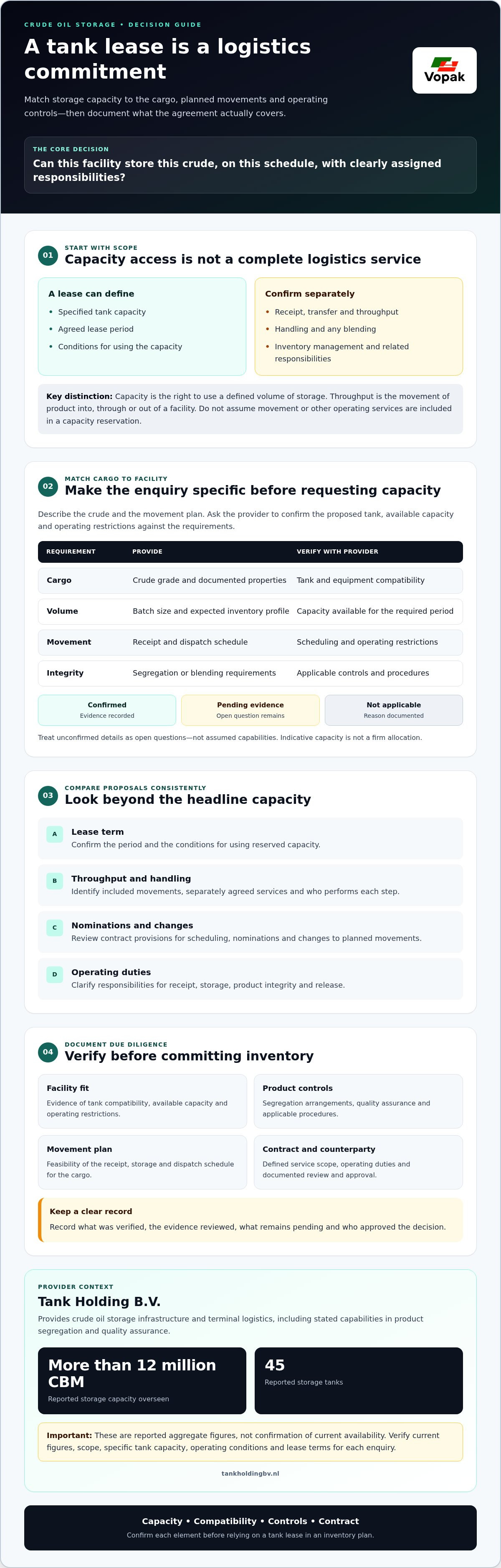
Capacity is the agreed right to use a defined volume of storage. Throughput concerns moving product into, through or out of a facility. Receipt, handling, transfer and blending are separate operating activities. The agreement should state which services are included, which require a separate agreement and who is responsible for each step.
Inventory management and blending also need explicit confirmation. Do not assume they are included in a capacity reservation. Before relying on them in an inventory plan, confirm the service scope, operating procedures, applicable charges and responsibilities in the contract. Tank suitability is cargo-specific, so check the facility’s tank specifications, segregation arrangements, quality assurance procedures and operating restrictions against the crude grade and planned movements.
Tank Holding B.V. provides crude oil storage infrastructure and terminal logistics, including stated capabilities in product segregation and quality assurance. It is a storage provider, not a crude oil seller or commodity trader. Confirm the specific tank, available capacity, throughput, handling scope and lease terms for each enquiry. Reported aggregate capacity does not confirm current availability.
Match the Tank Lease to Crude Grade, Cargo Handling and Inventory Needs
Tank suitability depends on the cargo. Before requesting capacity, document the crude grade, expected batch size, intended storage period and receipt or dispatch schedule. Include temperature, compatibility or handling requirements when supported by cargo documentation. This specification gives the provider a clear basis for confirming tank and equipment suitability, available capacity and operating restrictions.
Specify cargo and storage requirements before requesting capacity
Describe the movement plan as well as the inventory. One receipt followed by a planned release may require different scheduling from repeated deliveries or staged dispatches. Set out expected volumes and timing, then ask the provider to confirm which tank could accommodate the cargo and whether the proposed operating pattern is feasible. Treat details that have not been confirmed as open questions, not as assumed capabilities.
Use a cargo-to-capability table to structure the enquiry and record evidence before committing:
| Requirement | Information to provide | Provider confirmation |
|---|---|---|
| Cargo | Crude grade and documented properties | Tank and equipment compatibility |
| Volume | Batch size and expected inventory profile | Capacity available for the required period |
| Movement | Receipt and dispatch schedule | Scheduling and operating restrictions |
| Integrity | Segregation or blending requirements | Applicable controls and procedures |
Mark each facility detail as confirmed, pending evidence or not applicable. This makes gaps visible during review and prevents indicative capacity information from being mistaken for a firm allocation.
Protect product integrity through segregation and verification
Establish whether the cargo requires dedicated storage, isolated piping or separate manifolds. Ask how the facility prevents unintended contact with other products, and what sampling, testing, monitoring and recordkeeping procedures apply before receipt and during storage. Request documentation for the specific facility. Check any proposed blending against the cargo specification and trade plan, and define who authorises and records the operation.
Segregation controls must match the product specification. Without that match, the storage plan cannot reliably protect cargo identity and quality.
Align the lease scope with verified capability. Tank Holding B.V. states that it provides crude oil storage, product segregation and quality assurance. Confirm the specific tank, capacity, procedures and service terms for the cargo in question. Buyers assessing crude oil storage capabilities can use these requirements to frame a precise enquiry without treating reported capacity as current availability.
Compare Tank Lease Terms, Throughput and Operational Risk
Compare proposals using the same assumptions. A capacity figure alone does not show whether the tank is reserved for the required period, whether planned movements can be accommodated or which services are included. Build a comparison matrix from the draft terms and flag every point that remains unconfirmed.
- Capacity and term: Record the volume, reservation period, start date and any conditions for extending or reducing the commitment.
- Throughput and handling: Identify included receipt, transfer, blending and other activities. Separate these from services requiring a separate agreement.
- Scheduling: Compare nomination deadlines, scheduling processes and operating windows with the cargo plan.
- Use and change provisions: Review minimum-use requirements, treatment of unused capacity and procedures for changing nominations or volumes.
- Commercial terms: Request specific terms from each provider. Do not rely on general market rates or assume proposals use the same charging basis.
Use the same expected volumes, movement schedule and service scope for each request. Otherwise, differences between offers may reflect different assumptions rather than different lease value.
Separate capacity commitments from throughput and handling terms
Read the service boundaries closely. Confirm whether receipt, transfer and blending are included, separately agreed or excluded. Clarify how nominations are submitted, how schedules are confirmed and what happens if a planned movement changes. Provisions for extensions, unused capacity and amendments vary by agreement. Treat each as a contract point to review, not a standard industry term.
Allocate custody, quality and interruption risks clearly
The executed agreement should assign responsibility for custody transfer, measurement, sampling, product loss and quality disputes. Check which records support quantity and quality determinations, how discrepancies are raised and who must preserve relevant evidence. Confirm incident notification, escalation contacts and business continuity procedures in writing. A general promise to handle cargo safely does not replace defined responsibilities and processes.
Delays also need clear contractual treatment. Review the clauses governing scheduling changes, operational interruptions, notice, mitigation and resulting responsibilities. Ensure the contract reflects the actual movement plan and identifies where the provider’s obligations end and the customer’s begin.
A crude oil storage tank lease allocates risk through its executed terms. Unresolved responsibilities remain operational and contractual exposure. Compare the draft clauses, not just the capacity offer. Record deviations, request clarification and obtain legal and operational review before execution.
Crude Oil Tank Lease Due Diligence: A Practical Checklist
Complete a documented review before committing inventory. For crude oil storage tank leasing, assess the specific facility and contracting entity, not just the provider’s general capability statement. Treat claims about standards, permits, certifications or regulatory compliance as unverified until you have reviewed supporting documents and confirmed their relevance.
- 1. Define requirements. Record the cargo, grade, volume, storage period, movement schedule and required handling or segregation controls.
- 2. Request evidence. Obtain tank specifications, equipment details, capacity information, operating procedures and facility-specific quality assurance documentation.
- 3. Verify controls. Match the evidence to the cargo and planned movements. Identify gaps in compatibility, segregation, sampling, testing or monitoring.
- 4. Review terms. Compare the draft agreement with the verified operating scope. Check service responsibilities, escalation, reporting and interruption provisions.
- 5. Document approval. Record findings, unresolved questions, evidence owners and the people responsible for operational, legal and commercial approval.
Verify facility capability and operational controls
Compare written tank and equipment specifications with the documented cargo requirements. Request the procedures for sampling, testing, monitoring and product separation. Confirm which controls apply to the proposed tank and cargo, rather than relying on generic descriptions. Before contracting, establish operational contacts, escalation paths and reporting responsibilities for routine issues and incidents.
If a provider refers to a standard, certificate or permit, obtain the underlying document and check its scope, validity and relevance with a qualified adviser. Do not assume a facility-specific requirement is satisfied by a general company statement.
Review the counterparty and contract evidence
Confirm the legal entity that will sign the agreement and that its representative has authority to do so. Review available insurance evidence and relevant financial documentation as part of the counterparty assessment. Ask qualified advisers to determine which Dutch and international requirements apply to the facility, cargo and proposed activities. Do not assume a particular rule applies without that review.
Maintain a diligence register listing each document received, its review status, outstanding questions, the responsible evidence owner and the approval decision. Keep unresolved items visible until they are closed or formally accepted as exceptions. This provides a traceable basis for the lease decision.
To assess storage capability, product segregation and quality assurance against your cargo requirements, discuss crude oil storage requirements with Tank Holding B.V. Confirm facility-specific evidence, capacity and contractual scope before making a commitment.
When Tank Holding’s Crude Oil Storage Services May Fit
Tank Holding B.V. may suit buyers seeking crude oil storage supported by product segregation and quality assurance. Tank Holding B.V. states that its stated role is storage infrastructure and terminal logistics, not crude oil trading. Assess fit against the cargo and contract requirements, then confirm each relevant capability for the facility under consideration.
The company reports overseeing more than 12 million CBM of capacity across 45 storage tanks in international hubs. These figures describe reported aggregate capacity, not a confirmed lease allocation. Verify the current figures, the scope of capacity overseen and the availability of a specific tank directly with the provider.
Assess fit against the actual storage requirement
Separate confirmed service information from facility-specific details that still require enquiry. Match the cargo and planned inventory against documented tank compatibility, available capacity, segregation controls and quality assurance procedures. If the trade plan depends on throughput or blending, confirm whether the required activity is available and included in the proposed scope. Do not infer a tank, location or lease allocation from general capacity statements.
Use the same requirements to assess each provider. This helps your team identify gaps between a service description and the evidence for a specific operational arrangement. The petroleum storage facility solutions guide provides broader context for evaluating storage infrastructure.
Prepare a precise capacity enquiry
A complete request gives the provider a clear basis for checking fit. Include the crude grade, estimated volume, required dates and expected receipt and dispatch schedule. Specify any cargo-supported requirements for segregation, blending, sampling or documentation. Distinguish mandatory controls from preferences, and identify operating assumptions that still need confirmation.
Request a written response covering capacity available for the stated period, facility-specific operating scope, draft lease terms and supporting diligence materials. Ask the provider to identify exclusions, dependencies and unresolved details. This gives the commercial and operational teams a defined proposal to assess before progressing.
For crude oil storage tank leasing, a provider’s general service profile is a starting point, not proof of suitability. Proceed only after verifying the proposed capacity, cargo fit, service boundaries and contractual responsibilities for the intended arrangement.
Secure Capacity Through Verified Terms
Effective crude oil storage tank leasing depends on more than a capacity figure. Confirm that the proposed tank fits the cargo and movement plan, then distinguish reserved capacity from throughput, handling and other services. Review the contract for clear responsibility over scheduling, custody, quality issues and operational interruptions.
Complete a documented counterparty review before committing inventory. Verify facility-specific specifications, segregation controls, quality assurance procedures and applicable supporting evidence. Keep unresolved details visible until they are confirmed and the agreement reflects the intended operating scope.
Tank Holding states that it provides crude oil storage and terminal logistics, with product segregation and quality assurance among its stated services. Confirm the scope, availability and terms for the specific facility and cargo. Submit your crude oil storage requirements for review to begin a facility-specific assessment. With verified capacity and defined responsibilities, your team can advance its storage plan on a controlled basis.
Frequently Asked Questions
What is crude oil storage tank leasing?
Crude oil storage tank leasing is an agreement for access to specified storage capacity under defined commercial and operating terms. The lease may not include throughput, receipt, transfer, handling, blending or quality assurance services. Before signing, identify the provider’s obligations, your responsibilities and the facility evidence confirming cargo suitability. The executed agreement and relevant facility documentation determine the arrangement’s actual scope.
How do I choose a crude oil storage tank for a specific grade?
Choose a tank by matching the cargo specification to documented facility capability, not by nominal capacity alone. Provide the crude grade, expected volume, storage period and movement schedule. Ask the terminal to confirm compatibility, available capacity and operating restrictions in writing. Establish whether dedicated storage or product segregation is required, and whether blending or additional sampling forms part of the plan. Have technical and operational documents reviewed before committing.
What should a crude oil tank lease agreement include?
A lease should identify the capacity, term, commercial terms, throughput and handling scope, nomination procedures, operating responsibilities and provisions for changes. Review clauses covering custody, measurement, sampling, product quality, losses, delays, incidents and termination. The appropriate wording depends on the transaction and applicable law. Have qualified legal and commercial advisers review the draft. A general checklist can support review, but it is not a substitute for contract advice.
How can a terminal prevent crude oil cross-contamination?
Cross-contamination controls must match the cargo and facility. Review whether tanks, piping and manifolds are dedicated or suitably isolated, then verify applicable cleaning, sampling, testing and monitoring procedures. Confirm how product movements are recorded and how deviations are reported and managed. Request evidence for the specific facility and cargo. A general assurance does not establish operational suitability. Documented procedures and records provide the basis for assessment.
What due diligence should I complete before leasing tank capacity?
Verify the contracting entity, facility specifications, capacity availability, cargo compatibility, operating procedures and quality controls. Review relevant permits, insurance, certifications and compliance evidence with qualified advisers. Applicability depends on the facility, cargo and proposed activities. Examine the lease’s service boundaries, risk allocation and interruption provisions. Maintain a record of documents requested and received, open questions, responsible reviewers and approval decisions. Keep unresolved items visible before commitment.
Does a crude oil tank lease include throughput and handling?
Not necessarily. Capacity access is distinct from receipt, transfer, blending, sampling and other handling activities, each of which may have separate scope and commercial terms. Request a written service schedule and confirm which activities are included, separately agreed or subject to operating conditions. Compare proposals using the same service assumptions. The signed agreement and facility-specific documentation establish the actual obligations, not the general label used to describe the arrangement.
Frequently Asked Questions
Producers, refiners, traders, suppliers and distributors may use storage to position inventory, support supply continuity or coordinate import and export plans. Their requirements differ. A refiner may need storage that fits a specific grade and processing schedule, while a supplier may prioritise inventory availability across planned deliveries. Each user should define its cargo profile, movement pattern and contractual controls before requesting capacity.
Crude oil storage tank leasing is an agreement for access to specified storage capacity under defined commercial and operating terms. The lease may not include throughput, receipt, transfer, handling, blending or quality assurance services. Before signing, identify the provider’s obligations, your responsibilities and the facility evidence confirming cargo suitability. The executed agreement and relevant facility documentation determine the arrangement’s actual scope.
Choose a tank by matching the cargo specification to documented facility capability, not by nominal capacity alone. Provide the crude grade, expected volume, storage period and movement schedule. Ask the terminal to confirm compatibility, available capacity and operating restrictions in writing. Establish whether dedicated storage or product segregation is required, and whether blending or additional sampling forms part of the plan. Have technical and operational documents reviewed before committing.
A lease should identify the capacity, term, commercial terms, throughput and handling scope, nomination procedures, operating responsibilities and provisions for changes. Review clauses covering custody, measurement, sampling, product quality, losses, delays, incidents and termination. The appropriate wording depends on the transaction and applicable law. Have qualified legal and commercial advisers review the draft. A general checklist can support review, but it is not a substitute for contract advice.
Cross-contamination controls must match the cargo and facility. Review whether tanks, piping and manifolds are dedicated or suitably isolated, then verify applicable cleaning, sampling, testing and monitoring procedures. Confirm how product movements are recorded and how deviations are reported and managed. Request evidence for the specific facility and cargo. A general assurance does not establish operational suitability. Documented procedures and records provide the basis for assessment.
Verify the contracting entity, facility specifications, capacity availability, cargo compatibility, operating procedures and quality controls. Review relevant permits, insurance, certifications and compliance evidence with qualified advisers. Applicability depends on the facility, cargo and proposed activities. Examine the lease’s service boundaries, risk allocation and interruption provisions. Maintain a record of documents requested and received, open questions, responsible reviewers and approval decisions. Keep unresolved items visible before commitment.
Not necessarily. Capacity access is distinct from receipt, transfer, blending, sampling and other handling activities, each of which may have separate scope and commercial terms. Request a written service schedule and confirm which activities are included, separately agreed or subject to operating conditions. Compare proposals using the same service assumptions. The signed agreement and facility-specific documentation establish the actual obligations, not the general label used to describe the arrangement.